
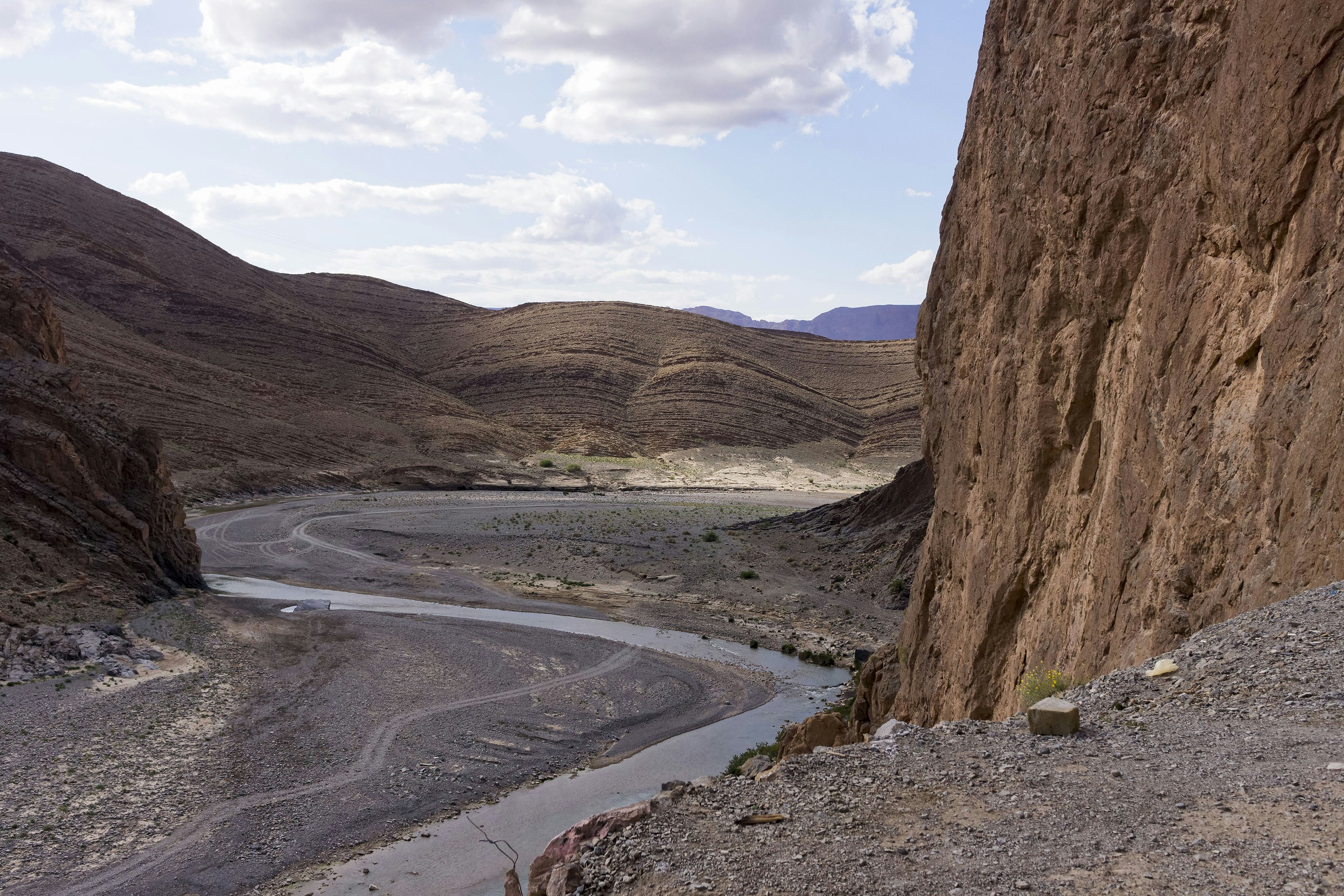
Tinghir is an oasis town in southeastern Morocco, built on a rocky shelf above a long palm oasis fed by the Todra River, and best known to travelers as the gateway town for Todra Gorge a short drive to the north. Beyond its role as a stopover, Tinghir has its own layered history, including a former Jewish quarter and a hilltop kasbah, along with a working palm oasis that remains central to the local economy.
The Palm Oasis
Below Tinghir’s town center, a long ribbon of palm oasis follows the Todra River for several kilometers, irrigated by a traditional channel system, known as khettara or seguia depending on the specific method, that has watered the terraced gardens for generations. Date palms form the upper canopy, with smaller fruit trees, vegetables, and fodder crops grown in the shade beneath, a layered planting style common across Morocco’s pre-Saharan oases. Walking paths through parts of the oasis give visitors a close look at this working agricultural landscape, distinct from the rocky, arid terrain surrounding the town itself.
The Old Kasbah and Jewish Quarter
Tinghir’s hillside kasbah, now largely in ruins, once anchored the town’s defenses and administrative center, overlooking the oasis below. Nearby, a former mellah, or Jewish quarter, reflects a Jewish community that lived in Tinghir for centuries before most residents emigrated in the mid-20th century, part of a broader wave of Jewish emigration from Morocco’s smaller oasis towns. Some structures associated with this history, including former synagogue buildings, remain visible today, though many are in a weathered, unrestored state.
Gateway to Todra Gorge
Tinghir’s main draw for most travelers is its position roughly 15 km south of Todra Gorge, a dramatic limestone canyon with walls rising several hundred meters on either side of a narrow road and riverbed. Most organized tours and independent travelers use Tinghir as a base for exploring the gorge, whether as a day trip or an overnight stop before continuing further into the Atlas Mountains or toward the desert routes further south.
Food in Tinghir
Tinghir’s food scene serves the steady flow of travelers passing through en route to Todra Gorge, with straightforward restaurants offering tagine, couscous, and grilled meats at moderate prices. Cafes overlooking the oasis or the palm groves below town offer a quieter alternative to the busier spots directly on the main road, and several serve mint tea and fresh bread that make for a pleasant late-afternoon stop after walking the oasis paths.
Where to Stay
Accommodation in Tinghir ranges from simple guesthouses to a handful of larger hotels, most catering to travelers using the town as a base for Todra Gorge rather than a standalone destination. Properties on the edge of town near the oasis often offer more scenic surroundings than those directly on the main through road, and a handful of guesthouses inside the palm groves themselves offer the quietest, greenest setting available in town.
Common Misconceptions
A common assumption is that Tinghir and Todra Gorge are the same place. In practice, Tinghir is a separate town roughly 15 km south of the gorge entrance, and travelers looking to visit the gorge itself need to continue north from the town. Another misconception is that Tinghir is purely a modern stopover with no history of its own. Its kasbah ruins and former Jewish quarter reflect a considerably older and more layered past than its current role as a gateway town suggests.
Best Time to Visit
Spring and autumn bring comfortable temperatures for walking the oasis and exploring Todra Gorge without the intense summer heat that can settle over this part of southeastern Morocco. Summer is hot, particularly at midday, making early morning or late afternoon the more comfortable times for outdoor activity. Winter is mild by day but can turn cold at night given the region’s elevation and desert-edge climate.
Practical Tips for Visiting
Tinghir works best as a one- or two-night base for exploring Todra Gorge rather than a multi-day destination in its own right. A short walk down into the palm oasis is worthwhile even for travelers focused mainly on the gorge, offering a different perspective on the region’s agricultural life. Comfortable walking shoes matter for both the oasis paths and the uneven terrain around the old kasbah, and a local guide is worth arranging for anyone wanting to explore the kasbah ruins or outlying villages in more depth.
Getting to Tinghir
Tinghir is roughly 165 km east of Ouarzazate, approximately 2.5 hours of driving along the N10 road. From Marrakech, Tinghir is roughly 380 km, approximately 6 to 6.5 hours of driving, typically routed through the Tizi n’Tichka pass and Ouarzazate. Buses and shared taxis connect Tinghir with Ouarzazate and other towns along the N10, making it reachable without a private vehicle, though a car offers more flexibility for exploring the surrounding oasis and gorge, and grand taxis can also be hired locally for the short run up to Todra Gorge itself.
How Tinghir Fits Into a Wider Morocco Trip
Tinghir works well as a stop on a route connecting Ouarzazate with the Dades Valley, Todra Gorge, and onward toward Merzouga and the Sahara, forming part of the classic southern Morocco loop. It generally suits travelers building an itinerary around the region’s canyons and desert routes rather than those focused on Morocco’s coastal or imperial cities.
A Brief History of Tinghir
Tinghir’s oasis has supported settlement for centuries, its location at the point where the Todra River emerges from the mountains onto flatter ground making it a natural spot for irrigation-based agriculture. The town grew as a market and administrative center for the surrounding Ait Atta and other Amazigh groups, with the kasbah serving as both a defensive structure and a seat of local authority during periods when control of the region was contested among rival groups. Tinghir’s Jewish community, like those in many pre-Saharan oasis towns, was involved historically in trade and craft work, including metalwork and jewelry, before emigrating in large numbers around the time of Moroccan independence and the founding of Israel. French colonial administration in the 20th century brought some infrastructure development to the wider region, though Tinghir remained a relatively small provincial town until growth accelerated in the postcolonial period alongside its emerging role in tourism tied to Todra Gorge.
Local Crafts and the Weekly Souk
Tinghir hosts a weekly souk drawing sellers from surrounding villages, offering produce, textiles, and household goods in a setting geared toward local commerce rather than tourist shopping. Carpet weaving has a long tradition in the wider Todra and Dades region, and some shops in Tinghir sell rugs produced by regional cooperatives, though the larger and more established carpet markets are generally found in bigger cities further west. Travelers interested in observing everyday Moroccan market life, rather than a curated tourist souk, may find Tinghir’s weekly market a more authentic option than the souvenir-oriented stalls found in more heavily visited towns.
Hiking Beyond the Oasis
Beyond the palm oasis itself, the hills and rocky terrain surrounding Tinghir offer walking routes that connect small Amazigh villages scattered across the landscape, some still built in traditional earthen construction similar to the region’s older kasbahs. These walks are generally less structured and less signposted than routes in better-known trekking areas further west in the High Atlas, so travelers interested in exploring beyond the oasis and gorge benefit from a local guide familiar with the terrain and village paths. The contrast between the lush, irrigated oasis and the stark surrounding hills is part of what makes this stretch of landscape distinctive, a visual pattern repeated at a larger scale throughout Morocco’s pre-Saharan oasis valleys.
Frequently Asked Questions
Is Tinghir the same as Todra Gorge?
No, Tinghir is a separate oasis town roughly 15 km from the entrance to Todra Gorge, and most travelers use Tinghir as a base or stopover before visiting the gorge itself.
How far is Tinghir from Ouarzazate?
Tinghir is roughly 165 km east of Ouarzazate, approximately 2.5 hours of driving along the N10 road.
Does Tinghir have a palm oasis?
Yes, Tinghir sits above a long palm oasis fed by the Todra River, with traditional irrigation channels still used to water the palms and terraced gardens below the town.
Did Tinghir have a Jewish community?
Yes, Tinghir had a significant Jewish population for centuries, with a mellah quarter and synagogue remains still visible, before most residents emigrated in the mid-20th century.
How far is Tinghir from Todra Gorge?
The entrance to Todra Gorge is roughly 15 km north of Tinghir, approximately 20 to 25 minutes of driving along the road that follows the Todra River.
How far is Tinghir from Marrakech?
Tinghir is roughly 380 km from Marrakech, approximately 6 to 6.5 hours of driving, typically routed through the Tizi n’Tichka pass and Ouarzazate.
Browse our Marrakech desert tours for the inland desert route, or see our full range of Marrakech tours if you’re planning a wider Morocco itinerary.