
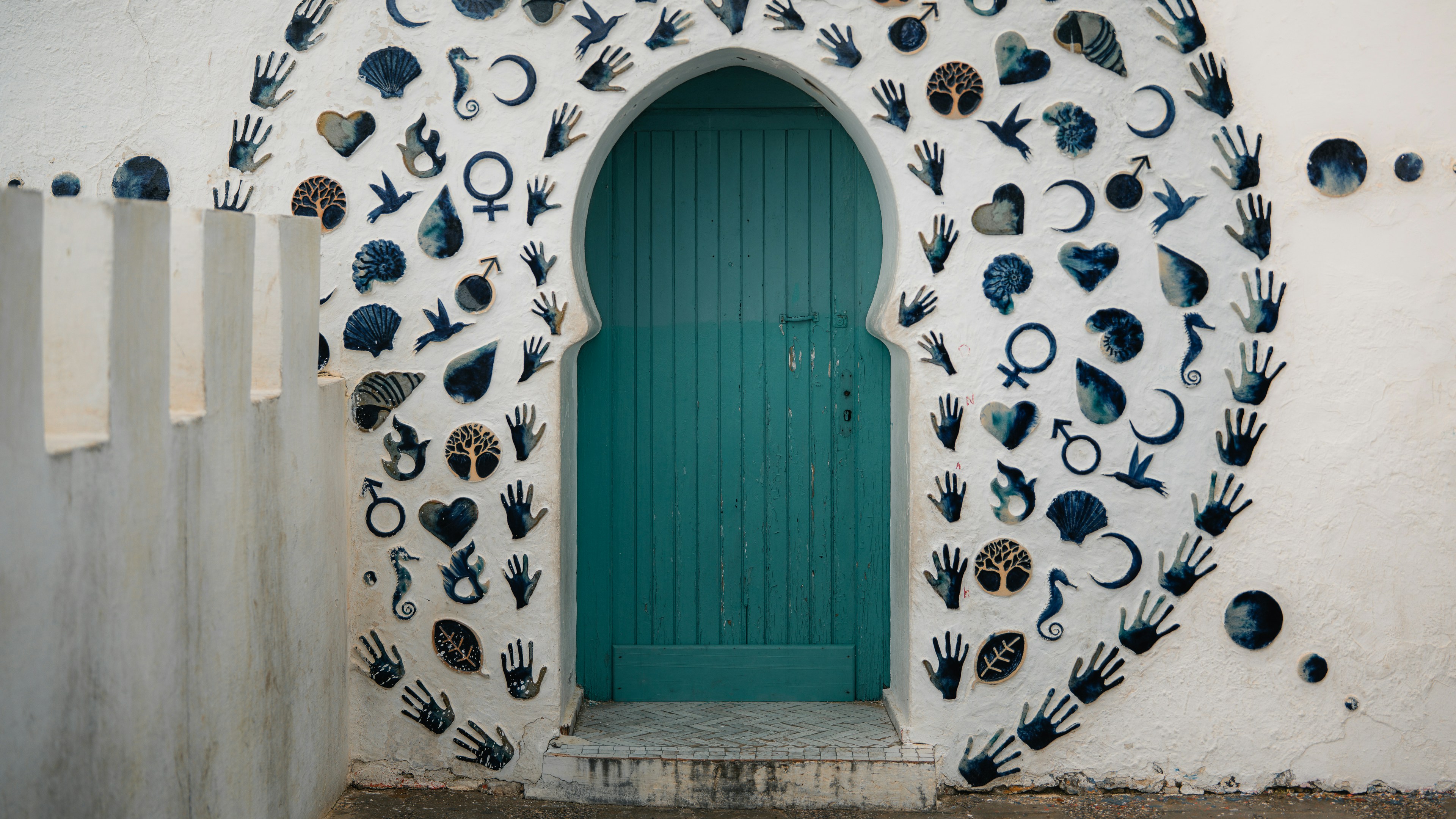
Asilah is a small fortified town on Morocco’s Atlantic coast south of Tangier, known for whitewashed medina walls repainted each year with murals, a legacy of an annual arts festival that has run since the late 1970s. The result is a walled old town that functions partly as a living outdoor gallery, alongside its older identity as a fishing port and Portuguese-era fortress.
The Murals
Asilah’s mural tradition began with the Asilah Arts Festival in 1978, when artists were invited to paint the medina’s whitewashed walls as part of a broader cultural revival for the town. The practice continued in the years since, with many murals repainted or replaced during each summer festival, so the specific artwork on view changes from year to year even as the tradition itself has become a fixed part of Asilah’s identity. Streets throughout the medina display this rotating collection, making a slow walk through the old town the main way to see it.
The Asilah Arts Festival
Held each summer, the Moussem Culturel International brings visiting artists, exhibitions, workshops, and performances to Asilah’s medina, with mural painting as its most visible activity. The festival draws both Moroccan and international artists, and the event has grown Asilah’s profile well beyond its size as a town, making the summer weeks its busiest and most colorful period by a wide margin.
The Portuguese-Era Ramparts
Asilah’s fortified walls date largely to a period of Portuguese occupation in the 15th and 16th centuries, when the town was held as a fortified coastal outpost. Sections of these ramparts still enclose the medina today, and a walk along parts of the walls gives views out over the Atlantic and the fishing harbor below, alongside a more tangible sense of the town’s fortified history than the murals alone convey.
The Medina and the Fishing Port
Inside the walls, Asilah’s medina is compact and easy to walk in an afternoon, with narrow whitewashed streets opening onto small squares and a working fishing harbor at its edge. Boats still bring in a daily catch sold and grilled close to the water, giving the town a working coastal identity that persists alongside its arts-festival reputation. Cats are a common sight around the harbor and fish stalls, a familiar feature of Moroccan coastal towns rather than anything specific to Asilah.
Food in Asilah
Given its position on the coast, Asilah’s restaurants lean heavily toward seafood, with fresh fish and shellfish grilled simply and served at cafes near the harbor and medina walls. Prices are generally lower than in Tangier, and the relaxed, small-town pace extends to the dining scene, with fewer formal restaurants and more simple, direct grilled-fish spots than a larger coastal city would have.
Where to Stay
Accommodation in Asilah ranges from simple guesthouses within the medina walls to slightly larger hotels along the modern part of town outside the ramparts. Rooms within the old town tend to book up during the summer festival weeks, so travelers planning a visit during that period benefit from booking well ahead, while the rest of the year sees considerably lighter demand. A handful of properties occupy converted historic houses along the ramparts, offering more character than the newer hotels outside the walls.
Common Misconceptions
A common assumption is that Asilah’s murals are a permanent, fixed collection like a formal gallery. In practice, many are repainted or replaced during each year’s festival, so the specific artwork seen on any given visit is temporary rather than a lasting installation. Another misconception is that Asilah is a large tourist town on the scale of Chefchaouen. It remains a small, quiet coastal town for most of the year, busiest only during the summer festival weeks.
Best Time to Visit
The summer arts festival period brings the most activity, color, and events, making it the liveliest time to visit despite larger crowds and warmer weather. Spring and autumn offer a quieter, calmer version of Asilah with comfortable temperatures for walking the medina and ramparts. Winter is quiet and cooler, with the Atlantic coastal wind more noticeable than during the summer months.
Getting to Asilah
Asilah is roughly 45 km south of Tangier, approximately 40 to 45 minutes of driving along the coast, and is also reachable by train on the line connecting Tangier to Rabat and Casablanca, with Asilah as one of the stops. Its proximity to Tangier’s airport and port makes it an easy add-on for travelers already routing through northern Morocco rather than a standalone destination requiring separate arrangements. Grand taxis also run the route for travelers who prefer not to drive themselves.
How Asilah Fits Into a Wider Morocco Trip
Asilah works well as a short coastal add-on to time spent in Tangier, either as a half-day or full-day trip or a overnight stay for travelers wanting a calmer alternative to Tangier’s larger, busier waterfront. It sits apart from the classic Marrakech-to-desert route, so it generally suits itineraries focused on northern Morocco rather than a stop built into a southern desert tour.
A Brief History of Asilah
Asilah has been fought over and resettled by several powers across its history, reflecting its position as a coastal outpost on the Strait of Gibraltar approach. Phoenician and later Roman traders used the site before it grew into a fortified town under a series of rulers, and the Portuguese held and rebuilt it as a garrison town in the 15th century, work that left the ramparts still visible today. Spain later administered the town during the colonial period in northern Morocco, and Asilah returned to full Moroccan control with independence in 1956. This layered history, Amazigh, Arab, Portuguese, and Spanish, is part of what distinguishes Asilah from towns further south that never came under the same coastal fortification pressures.
Shopping and Local Crafts
Asilah’s medina has a smaller, quieter shopping scene than Tangier or Chefchaouen, with a handful of galleries and craft shops selling paintings, ceramics, and textiles alongside the usual leather goods and souvenirs. Because the town’s identity leans on its arts festival, original paintings and prints by local and visiting artists are more prominent here than in many other Moroccan medinas, and prices are generally more negotiable outside the peak festival weeks when demand is lower. A small daily market near the edge of the medina sells produce and household goods for residents rather than tourists, giving visitors a glimpse of the town’s ordinary rhythms beyond the murals.
Nearby Beaches and Day Trips
Asilah sits right on the Atlantic, and its own beach runs along the edge of town, drawing local families and visitors alike outside the busiest festival weeks. Travelers with more time can continue further down the coast toward Larache, a fishing town with its own Spanish colonial-era architecture and access to the ruins of ancient Lixus nearby. Both make reasonable half-day additions for travelers based in Asilah for a couple of nights rather than passing straight through on a single day trip from Tangier.
Practical Tips for Visiting
The medina is small enough to see on foot in a few hours, so comfortable walking shoes are more important than any particular pace or route. Photography of the murals is generally welcome, though travelers photographing residents directly should ask first, as with anywhere in Morocco. Restaurants and shops keep more limited hours outside the summer festival season, so travelers visiting in winter should not expect the same evening activity found in larger northern cities. Cash remains the most reliable way to pay in smaller shops and market stalls, even though larger hotels and restaurants generally accept cards.
Frequently Asked Questions
Why is Asilah famous for murals?
Asilah’s medina walls have been painted with murals since an annual arts festival began in the late 1970s, and many are repainted or replaced each summer, giving the whitewashed old town a rotating outdoor gallery feel.
How far is Asilah from Tangier?
Asilah is roughly 45 km south of Tangier, approximately 40 to 45 minutes of driving or a similar train journey along the Atlantic coast.
What is the Asilah arts festival?
The Asilah Arts Festival, known locally as the Moussem Culturel International, is an annual summer event featuring mural painting, exhibitions, and cultural performances held in the medina since 1978.
Does Asilah have Portuguese-era walls?
Yes, Asilah’s ramparts date largely to a period of Portuguese occupation in the 15th and 16th centuries, and sections of these fortified walls still enclose the medina today.
Can Asilah be visited as a day trip from Tangier?
Yes, Asilah is a common half-day or full-day trip from Tangier, easily reached by car, taxi, or train given the short distance between the two towns.
Is Asilah touristy?
Asilah draws steady visitor numbers, especially during the summer arts festival, but it remains considerably smaller and calmer than Tangier or Chefchaouen for most of the year.
Browse our Marrakech desert tours for the inland desert route, or see our full range of Marrakech tours if you’re planning a wider Morocco itinerary.