
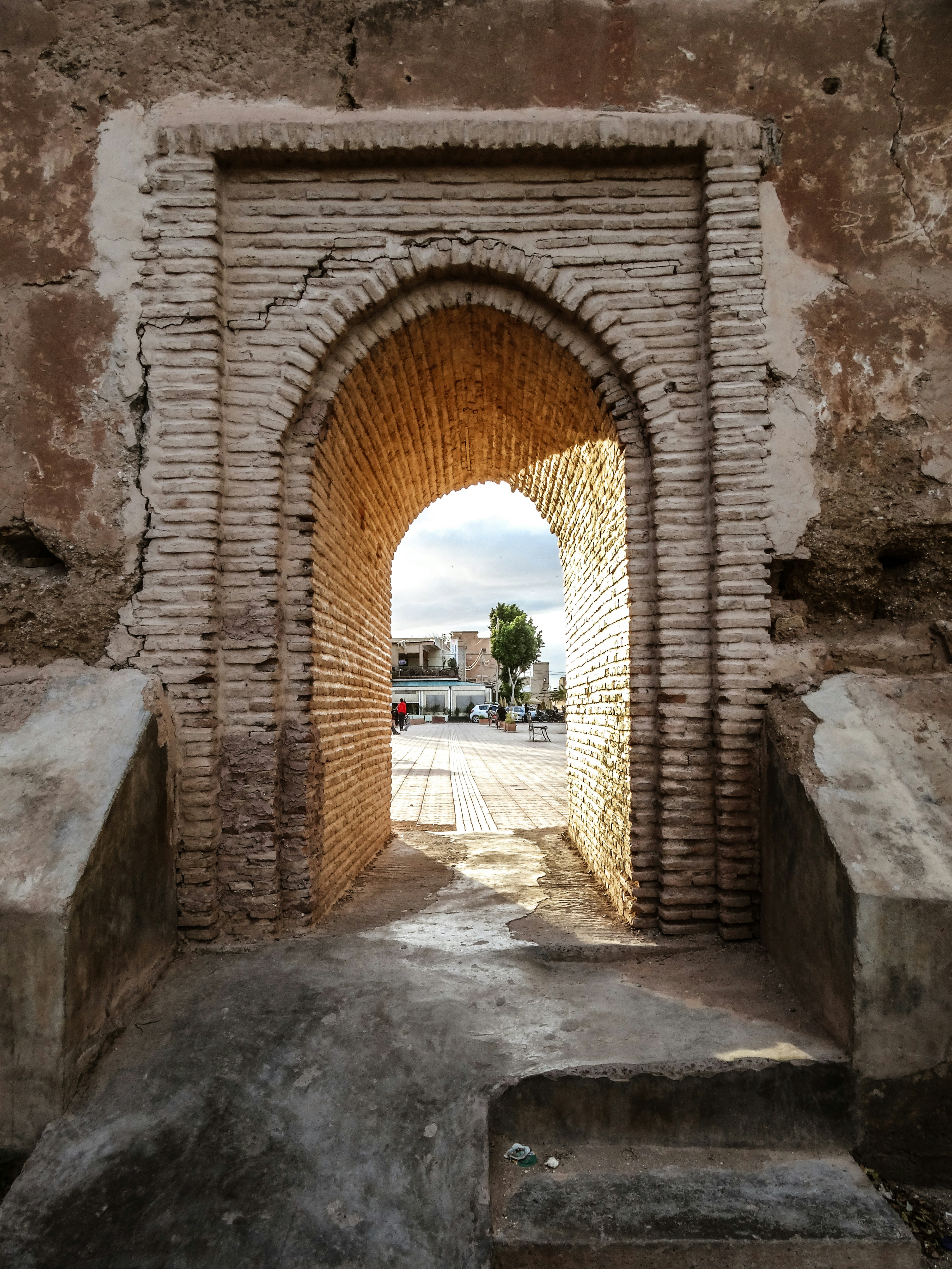
Taroudant is a walled market town in southern Morocco’s Souss Valley, often nicknamed mini-Marrakech for its intact red pise ramparts and busy souks, on a scale that is smaller and considerably less touristed than its famous namesake. It has kept a working, everyday character that has faded in parts of Marrakech’s old city, making it a popular stop for travelers looking for a similar medina atmosphere without the crowds. Set between the High Atlas and Anti-Atlas ranges, the town also makes a convenient base for exploring the wider Souss Valley beyond its own walls.
The Ramparts
Taroudant’s red pise, or rammed-earth, ramparts run for roughly 7.5 km around the old town and are among the best-preserved city walls in Morocco, largely intact rather than partially ruined as in many other historic Moroccan cities. Dating in their current form to the 16th century, though built on earlier fortifications, the walls are commonly toured by bicycle, horse-drawn carriage, or car, a loop that takes in several of the old gates and offers views back over the town and out toward the surrounding Souss Valley and distant Atlas peaks.
Why Taroudant Is Called Mini-Marrakech
The nickname comes from the resemblance between Taroudant’s walled medina and souk layout and Marrakech’s old city, both built around red earthen walls and a dense grid of market streets. Unlike Marrakech, however, Taroudant sees a fraction of the visitor numbers, and its souks function more as everyday commerce for the surrounding Souss Valley than as a tourist-oriented shopping district, giving it a noticeably different feel despite the visual similarity.
The Two Souks
Taroudant has two main souks rather than one continuous market. The Arab souk is known for leather goods, jewelry, and antiques, while the Berber souk, held in a large open square, focuses on produce, spices, household goods, and livestock on market days. This division gives visitors a clearer sense of the town’s dual character, part historic trading center and part working agricultural market town for the Souss Valley’s farms.
The Tannery Quarter
Taroudant has a small tannery quarter on the edge of town, considerably smaller and less visited than Fes’s famous tanneries but operating on similar traditional lines, with hides treated and dyed in open pits using methods that have changed little over generations. Visitors can arrange a visit through local guides, offering a quieter, less crowded look at a craft more commonly associated with Morocco’s larger imperial cities.
Jewelry and Silverwork
Taroudant has long been known as a center for silver jewelry, historically drawing Amazigh silversmiths and Jewish artisans whose work shaped the region’s distinctive style before Morocco’s Jewish community largely emigrated in the mid-20th century. Shops around the Arab souk still sell silver jewelry, antique and new, alongside other metalwork, and the town remains a reference point for collectors interested in southern Moroccan silver design. Prices and quality vary considerably between shops, so travelers serious about buying often ask their guesthouse for a recommendation rather than choosing at random.
The Souss Valley
Taroudant sits within the Souss Valley, a wide agricultural plain between the High Atlas and Anti-Atlas mountain ranges, irrigated by the Souss River and known for citrus orchards, vegetable farming, and argan tree cover. This fertile setting distinguishes Taroudant from the arid kasbah country further east, and the surrounding farmland is part of what has supported the town’s souks and trading economy for centuries.
Food in Taroudant
Taroudant’s restaurants serve much the same range as elsewhere in Morocco, tagine, couscous, and grilled meat, though the Souss Valley’s citrus and produce show up more often on local menus given the surrounding farmland. A handful of riads and guesthouses within the walls offer rooftop dining with views over the medina and out toward the ramparts, a quieter setting than the busier restaurant terraces found in Marrakech’s Jemaa el-Fna area. Cafes around the two main squares are a common stop for mint tea between souk visits.
A Brief History of Taroudant
Taroudant has served as a regional capital at several points in Moroccan history, including a period as the capital of the Saadian dynasty before power shifted to Marrakech in the 16th century. Its position in the fertile Souss Valley made it a natural center for trade and agriculture long before that, and the ramparts standing today largely date from this Saadian-era peak, built to defend a town that was, for a time, among the most significant in the region. This history is part of why the walls are so extensive and well preserved compared to smaller fortified towns elsewhere in the south.
Where to Stay
Accommodation in Taroudant ranges from simple guesthouses within the medina walls to larger riad-style properties, generally at lower prices than comparable options in Marrakech given the smaller visitor numbers. Several properties are built directly against or near the ramparts, giving views over the walls or the surrounding countryside that are harder to find in more built-up Moroccan medinas.
Day Trips from Taroudant
The Souss Valley around Taroudant offers a few worthwhile side trips for travelers with a car or a guide. Small argan oil cooperatives dot the valley and surrounding hills, many open to visitors for a look at the traditional extraction process. The road toward Tafraoute and the Anti-Atlas is also reachable from Taroudant, making the town a reasonable base for combining ramparts and souks with a further detour into granite boulder country to the south.
Common Misconceptions
A common assumption is that Taroudant is simply a smaller copy of Marrakech with little of its own character. In practice, its two-souk system, intact ramparts, and working agricultural setting in the Souss Valley give it a distinct identity rather than a diminished version of a better-known city. Another misconception is that the ramparts can be freely walked along the top, as with some European city walls. Access is generally limited to guided or organized tours of specific sections rather than open walking along the entire loop.
Best Time to Visit
Spring and autumn bring comfortable temperatures for walking the souks and touring the ramparts, avoiding the intense summer heat that settles over the Souss Valley. Winter days are generally mild, making Taroudant a reasonable year-round destination compared to higher-elevation stops on a Morocco itinerary. Summer heat can be significant, and midday hours are best spent indoors or moving on to the next stop of a wider trip.
Practical Tips for Visiting
The medina streets inside the ramparts are generally easier to navigate than Marrakech’s, given the smaller scale and simpler layout, but comfortable walking shoes still matter for a day spent moving between the two souks. Bargaining is expected in both souks, particularly for jewelry, leather, and antiques, and taking time to compare prices across a few stalls is standard practice rather than an inconvenience. Market days bring noticeably larger crowds to the Berber souk, so travelers wanting a quieter visit may prefer a weekday outside the main trading days.
Getting to Taroudant
Taroudant is roughly 80 km from Agadir, approximately 1.5 hours of driving through the Souss Valley, and roughly 220 km from Marrakech, approximately 4 hours, usually routed over the dramatic Tizi n’Test pass through the High Atlas rather than the more commonly used Tizi n’Tichka route further east. This alternate mountain crossing is itself a scenic draw for travelers with extra time and a preference for a less-trafficked road. There is no commercial airport directly serving Taroudant, so travelers arriving by air typically fly into Agadir or Marrakech before continuing overland.
How Taroudant Fits Into a Wider Morocco Trip
Taroudant works well as a stop on a southern loop connecting Marrakech, the Souss Valley, and Agadir, particularly for travelers taking the Tizi n’Test route rather than backtracking over the same pass twice. It also pairs naturally with time in Agadir or Taroudant’s surrounding countryside for travelers prioritizing a quieter, more local medina experience over Marrakech’s larger, more tourist-oriented old city.
Frequently Asked Questions
Why is Taroudant called mini-Marrakech?
Taroudant is nicknamed mini-Marrakech because of its intact red pise ramparts and souk-centered medina, which resemble Marrakech’s old city on a smaller, quieter scale.
How far is Taroudant from Agadir?
Taroudant is roughly 80 km from Agadir, approximately 1.5 hours of driving through the Souss Valley.
Can you walk on Taroudant’s ramparts?
The ramparts themselves are not generally open for walking along the top, but visitors commonly tour the roughly 7.5 km perimeter by bicycle, horse-drawn carriage, or car.
How far is Taroudant from Marrakech?
Taroudant is roughly 220 km from Marrakech, approximately 4 hours of driving, usually routed over the Tizi n’Test pass through the High Atlas.
Does Taroudant have two souks?
Yes, Taroudant has two main souks, the Arab souk known for leather goods and jewelry, and the Berber souk known for produce, spices, and everyday goods.
Is Taroudant less touristy than Marrakech?
Yes, Taroudant receives considerably fewer visitors than Marrakech, giving its souks and medina a more everyday, working character rather than a heavily tourist-oriented one.
Browse our Marrakech desert tours for the inland route, or see our full range of Marrakech tours if you’re planning a wider Morocco itinerary.