
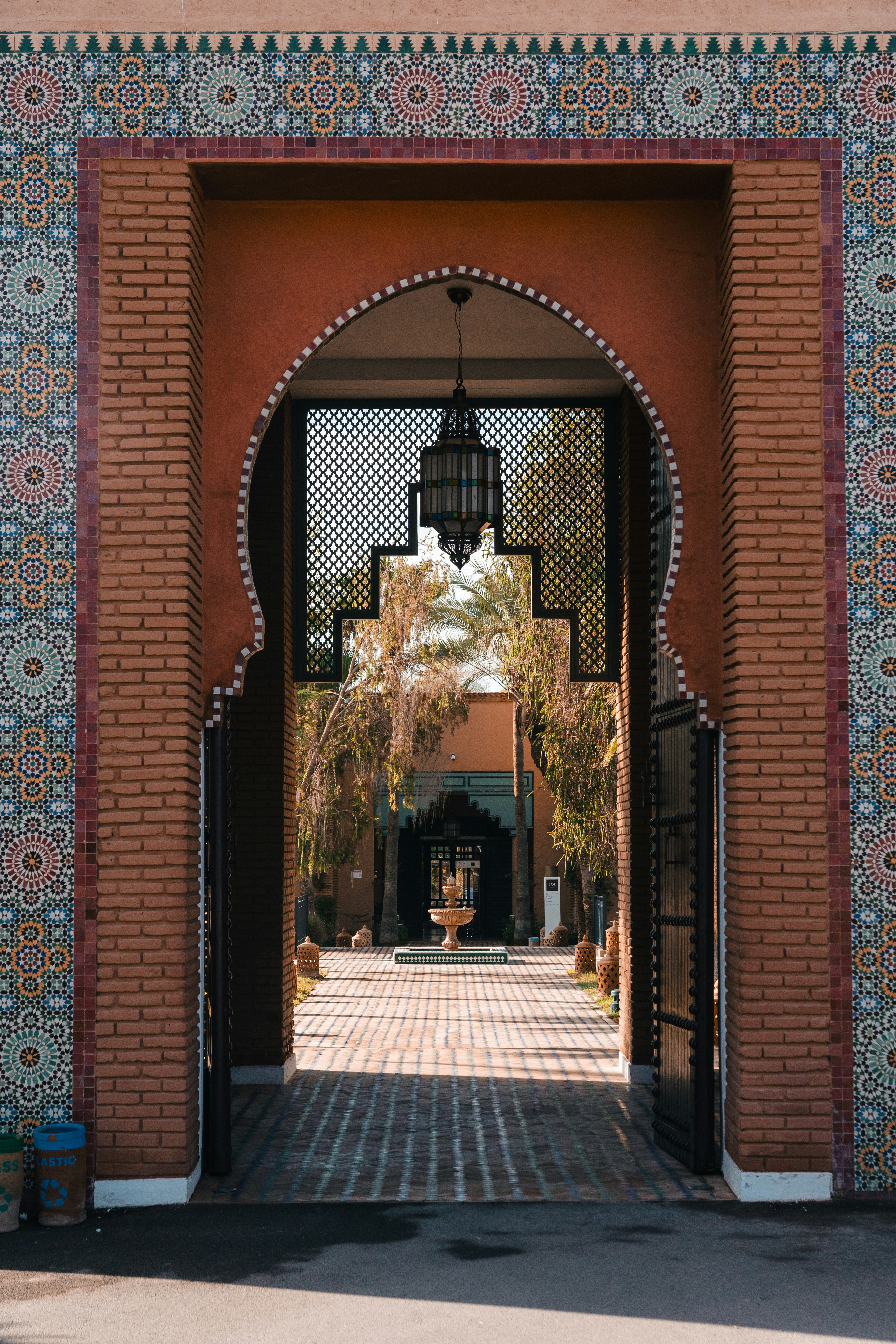
Meknes is one of Morocco’s four imperial cities, built up dramatically in the 17th century under Sultan Moulay Ismail, who made it his capital and left behind monumental gates, granaries, and stables on a scale that still dominates the city today. Despite this imperial history, Meknes receives far fewer visitors than nearby Fes, giving its medina and monuments a quieter, less commercial atmosphere, and its proximity to the Roman ruins of Volubilis makes it a natural stop for travelers exploring Morocco’s northern imperial cities. Its position within a fertile agricultural plain also sets it apart from Morocco’s more arid inland cities.
Bab Mansour
Bab Mansour is Meknes’ most famous monument, a massive ceremonial gate completed in the early 18th century and considered one of the most elaborate gateways in North Africa. Its green and white zellige tilework and horseshoe arch mark the entrance to the old imperial city, and the gate remains the city’s most photographed landmark, anchoring the large square, Place El Hedim, that sits in front of it.
The Royal Granaries and Stables
Moulay Ismail built vast granaries and stables, known as Heri es-Souani, designed to hold grain and house thousands of horses for his imperial army. The scale of these structures, with thick walls and a system built to keep supplies cool, gives visitors a sense of the sultan’s ambitions for Meknes as a self-sufficient imperial capital. Parts of the complex remain standing today and are open to visitors, offering one of the more striking examples of Moroccan imperial-era engineering.
Place El Hedim and the Medina
Place El Hedim, the large square fronting Bab Mansour, serves as a gathering point and informal market space, smaller and less chaotic than Marrakech’s Jemaa el-Fna but built on a similar model. Beyond the square, Meknes’ medina holds a working souk and a network of streets that, while less extensive than Fes’s, retain a genuine, largely local character rather than a heavily tourist-oriented one.
Volubilis
The Roman ruins of Volubilis sit roughly 30 km from Meknes, preserving mosaics, columns, and the layout of a substantial Roman settlement on the edge of the empire. The site is commonly visited as a half-day trip from Meknes, often combined with a stop in the nearby holy town of Moulay Idriss, and is considered one of the best-preserved Roman sites in Morocco.
Moulay Idriss Zerhoun
Moulay Idriss, a hillside town near Volubilis, is one of Morocco’s holiest sites, named for the founder of the country’s first Islamic dynasty and traditionally a pilgrimage destination for Moroccan Muslims. The town was closed to non-Muslim overnight visitors for much of its history, though it has opened considerably to tourism in recent decades, and its whitewashed hillside streets make it a natural addition to a Volubilis day trip.
Food in Meknes
Meknes sits within a fertile agricultural region known for olives and wine grapes, and its food scene reflects this, with olive products and regional produce appearing more prominently than in some other Moroccan cities. Restaurants around the medina and Place El Hedim serve the standard range of tagine, couscous, and grilled meats, generally at lower prices than comparable spots in Fes or Marrakech given the smaller tourist volume.
A Brief History of Meknes
Meknes existed as a smaller settlement for centuries before Sultan Moulay Ismail chose it as his capital in the late 17th century, embarking on decades of construction that included the ramparts, granaries, stables, and palaces that still define the city. Moulay Ismail’s long reign, one of the longest in Moroccan history, gave the city time to grow into a full imperial capital before the capital later shifted elsewhere, leaving Meknes with an outsized architectural legacy relative to its modern size and visitor numbers.
Where to Stay
Accommodation in Meknes ranges from simple guesthouses in the medina to riads converted from historic houses, generally at lower prices than equivalent options in Fes or Marrakech. The relative lack of tourist crowds means rooms are usually easier to book on short notice, even during Morocco’s busier travel seasons. A few properties near Place El Hedim offer rooftop views directly onto Bab Mansour.
Common Misconceptions
A common assumption is that Meknes is a minor stop compared to Morocco’s other imperial cities. In practice, its monuments, particularly Bab Mansour and the royal granaries, rank among the more impressive imperial-era architecture in the country, even if the city draws a fraction of the visitors that Fes or Marrakech do. Another misconception is that Volubilis is difficult to reach without a full tour. It is a straightforward half-day trip by taxi or car from Meknes.
Best Time to Visit
Spring and autumn bring comfortable temperatures for walking the medina and visiting Volubilis, avoiding the heat that can settle over the region in summer. Winter is generally mild by comparison to Morocco’s mountain destinations, making Meknes a reasonable year-round stop. Summer heat can be significant during midday hours, particularly at the exposed Volubilis site.
Practical Tips for Visiting
Meknes’ medina is generally easier to navigate than Fes’s, with a simpler layout and considerably less pressure from touts and unofficial guides given the smaller tourist numbers. A half-day is usually enough for Bab Mansour, the granaries, and Place El Hedim, leaving time for a separate half-day trip to Volubilis and Moulay Idriss. Comfortable walking shoes matter for both the medina streets and the uneven ground at Volubilis, and sun protection is worth packing given the site’s limited shade.
Getting to Meknes
Meknes is roughly 60 km from Fes, approximately 1 hour of driving or a similar train journey, making the two cities easy to combine on a single trip. From Marrakech, Meknes is roughly 480 km, approximately 6 to 7 hours of driving, typically routed through Casablanca and Rabat. Meknes has its own train station with regular connections to Fes, Rabat, and Casablanca, making rail a practical option for travelers without a car. Buses and shared grand taxis also connect Meknes to surrounding towns for those on a tighter budget.
Moulay Ismail’s Mausoleum
The mausoleum of Moulay Ismail, resting place of the sultan who built Meknes into an imperial capital, remains one of the few religious sites in Morocco open to non-Muslim visitors. Its courtyards, decorated with tilework and carved plaster in the style typical of Moroccan religious architecture, give visitors a rare look inside a still-functioning mausoleum rather than a purely secular monument. Modest dress is expected, as at any religious site in Morocco, and visitors should be mindful that it remains an active place of prayer rather than a purely historical site.
Shopping and Crafts
Meknes’ souks are smaller and less overwhelming than those of Fes or Marrakech, with a similar range of leather goods, textiles, and metalwork alongside local products tied to the surrounding agricultural region, including olive oil and preserved olives. The relative lack of tourist pressure makes bargaining here generally more relaxed than in Morocco’s larger, more visited markets.
How Meknes Fits Into a Wider Morocco Trip
Meknes works well as a stop on a northern imperial-cities route connecting Fes, Meknes, and Rabat, often paired with Volubilis and Moulay Idriss as a single extended day. It generally suits travelers building an itinerary around Morocco’s imperial history and northern cities rather than those focused primarily on the Marrakech-to-desert route further south.
Meknes Wine Country
The region around Meknes, particularly toward the town of Ben Slimane and the wider Sais plain, is one of Morocco’s main wine-producing areas, a legacy of French colonial-era vineyards that continued after independence. Several vineyards still operate in the countryside outside the city, and Meknes-area wine appears on restaurant lists throughout Morocco, an unusual detail for a country whose population is majority Muslim, and a reflection of Meknes’ distinct agricultural and colonial-era history.
Frequently Asked Questions
What is Meknes known for?
Meknes is known for its monumental Bab Mansour gate, its history as an imperial capital under Sultan Moulay Ismail, vast royal granaries and stables, and its proximity to the Roman ruins of Volubilis.
How far is Meknes from Fes?
Meknes is roughly 60 km from Fes, approximately 1 hour of driving or a similar train journey.
Is Meknes one of Morocco’s imperial cities?
Yes, Meknes is one of Morocco’s four imperial cities, alongside Fes, Marrakech, and Rabat, having served as the capital under Sultan Moulay Ismail in the 17th century.
Can you visit Volubilis from Meknes?
Yes, the Roman ruins of Volubilis are roughly 30 km from Meknes, approximately 30 to 40 minutes of driving, making it a common half-day trip from the city.
How far is Meknes from Marrakech?
Meknes is roughly 480 km from Marrakech, approximately 6 to 7 hours of driving, typically routed through Casablanca and Rabat or via Beni Mellal.
Is Meknes less crowded than Fes?
Yes, Meknes generally receives far fewer visitors than Fes despite its imperial history, giving its medina and monuments a considerably quieter, less commercial atmosphere.
Browse our Marrakech desert tours for the inland desert route, or see our full range of Marrakech tours if you’re planning a wider Morocco itinerary.