
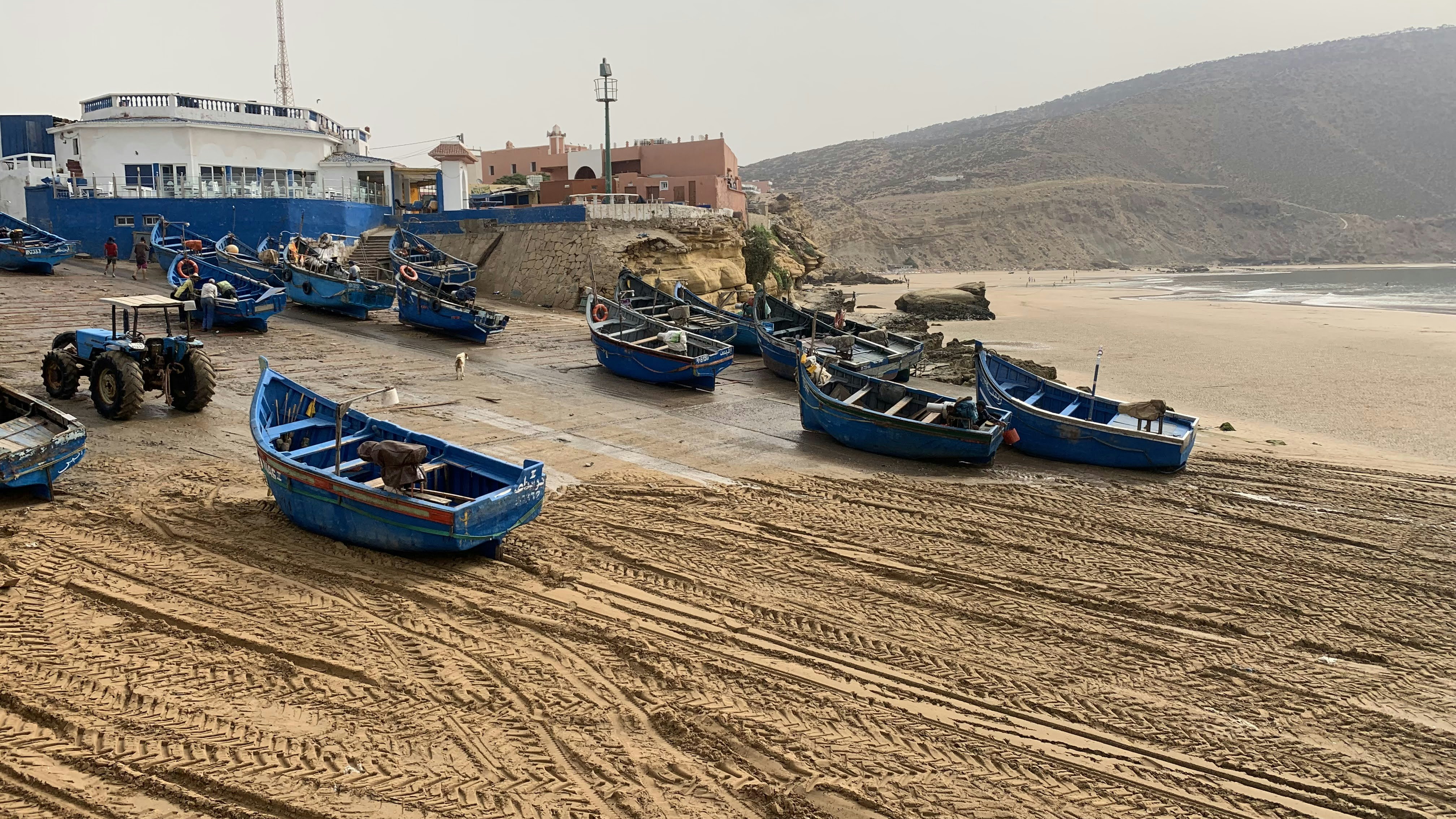
Sidi Ifni is a small coastal town in southern Morocco, notable for a town center built in Spanish colonial Art Deco style during the decades it remained a Spanish enclave, only returning to full Moroccan control in 1969. The result is a cluster of pastel-colored 1930s buildings overlooking the Atlantic, unlike almost anywhere else in the country, paired with a working fishing port and a laid-back pace that has drawn a steady trickle of independent travelers over the years.
Spanish Colonial Art Deco Architecture
Sidi Ifni’s town center was largely built during the Spanish administration of the 1930s, when planners laid out the plaza and surrounding streets in a distinctly Art Deco style, with pastel facades, rounded corners, and geometric detailing rare elsewhere in Morocco. Plaza Hassan II, formerly Plaza de España, remains the architectural centerpiece, ringed by buildings that would look more at home in a Spanish seaside town than a Moroccan one. Restoration has been uneven over the decades, giving some buildings a faded, sun-bleached character that adds to rather than detracts from the town’s distinct visual identity.
A Late Return to Moroccan Control
Spain held Sidi Ifni as a colonial enclave long after Morocco’s broader independence in 1956, only handing the territory back in 1969 following international pressure and negotiation. This delayed transition set Sidi Ifni apart from the rest of the country’s colonial history, and the town’s Spanish-built infrastructure and architecture remain the most visible legacy of that longer administration.
The Old Port and Cable Line
Sidi Ifni’s original port relied on a now-disused aerial cable system that once lowered goods down the cliffside to boats anchored offshore, a solution born from the town’s dramatic coastal topography. The structure remains visible today, a rusted reminder of the engineering challenges posed by building a working port on a clifftop. A newer, more conventional port now handles the town’s fishing fleet at sea level, and the old cable structure has become an informal landmark that visitors often photograph alongside the clifftop views.
Legzira Beach and the Rock Arches
Roughly 12 km north of Sidi Ifni, Legzira Beach is known for a pair of natural rock arches carved into red sandstone cliffs by centuries of Atlantic wave action, among the more distinctive coastal formations in Morocco. One of the two arches collapsed in 2016, and the remaining arch continues to draw photographers and casual visitors, best seen at low tide when more of the beach is exposed. The beach itself extends well beyond the arches, offering a long stretch of relatively undeveloped coastline, with a few simple cafes near the main access point but little else in the way of built-up infrastructure.
Food in Sidi Ifni
Seafood dominates Sidi Ifni’s food scene given its working fishing port, with simple restaurants around the town center serving fresh grilled fish and shellfish at prices generally lower than in more touristed coastal cities further north. The town’s small size means dining options are limited compared to Agadir or Essaouira, but the quality and freshness of the seafood remain a consistent draw.
Where to Stay
Accommodation in Sidi Ifni ranges from simple guesthouses to a handful of small hotels, several occupying restored or partially restored Art Deco buildings that lean into the town’s architectural character. Options are more limited than in larger coastal towns, reflecting Sidi Ifni’s smaller, less commercially developed tourism scene, so travelers with specific preferences on location or view should book a few days ahead rather than arriving without a reservation.
Common Misconceptions
A common assumption is that Sidi Ifni’s colonial history matches the rest of Morocco, having gained independence in 1956 alongside the broader country. In practice, Spain retained the enclave until 1969, more than a decade later, giving the town a distinct historical timeline. Another misconception is that Legzira Beach still has two rock arches. One collapsed in 2016, leaving a single remaining arch as the beach’s main landmark today.
Best Time to Visit
Spring and autumn offer comfortable temperatures for walking the town and visiting Legzira Beach without the stronger midday heat of summer. Summer brings warmer weather and the steadiest stream of domestic and regional visitors, while winter is quieter and cooler, with the Atlantic wind more noticeable along the clifftop streets.
Practical Tips for Visiting
Sidi Ifni is compact enough to explore on foot in a few hours, with Plaza Hassan II and the old cable-port structure as the main architectural anchors. A car is useful for reaching Legzira Beach and other stretches of coastline outside town, since public transport options in this part of southern Morocco are more limited than further north. Tide times are worth checking before a Legzira Beach visit, since the remaining arch and surrounding sand are considerably more exposed at low tide.
Getting to Sidi Ifni
Sidi Ifni is roughly 165 km south of Agadir, approximately 2.5 hours of driving along the Atlantic coastal road. From Marrakech, Sidi Ifni is roughly 370 km, approximately 5.5 to 6 hours of driving, typically routed through Agadir. There is no rail connection to Sidi Ifni, so travelers generally arrive by car, bus, or organized transport from Agadir, and renting a car in Agadir remains the most flexible option for combining the town with Legzira Beach and Mirleft in a single trip.
How Sidi Ifni Fits Into a Wider Morocco Trip
Sidi Ifni works well as a stop on a southern Atlantic coastal route connecting Agadir with Tan-Tan and points further south toward the Western Sahara region, offering a quieter, more architecturally distinct alternative to the busier beach towns further north. It generally suits travelers with a specific interest in coastal drives and colonial-era architecture rather than those focused on the classic Marrakech-to-desert route.
A Brief History of Sidi Ifni
Spain first established a presence at Sidi Ifni in the 15th century as Santa Cruz de la Mar Pequeña, a coastal trading post that was later abandoned for centuries before Spain reasserted a claim to the area in the late 19th century under a treaty with Morocco. Formal Spanish administration of the enclave began in the 1930s, when the modern town was laid out and built in the Art Deco style that still defines its center today. Sidi Ifni functioned as the capital of Spanish Ifni, a small colonial territory distinct from Spain’s other Moroccan holdings further north, until Morocco pressed for its return through the 1960s, a process that concluded with the 1969 handover.
The Souk and Local Life
Sidi Ifni’s weekly souk draws sellers and buyers from surrounding rural areas, offering a more workaday market experience than the souvenir-oriented souks of Marrakech or Fes. Everyday goods, produce, and household items dominate the stalls rather than tourist crafts, giving visitors a clearer sense of the town’s ordinary rhythms outside its architectural draw. Local life in Sidi Ifni still moves at a noticeably slower pace than Morocco’s larger coastal cities, a quality longtime visitors and residents often point to as part of the town’s appeal.
Surfing and the Southern Coast
The stretch of Atlantic coastline around Sidi Ifni sees fewer surfers than the well-known breaks near Taghazout further north, but several beaches in the area offer workable waves for travelers willing to explore beyond the established surf towns. Mirleft, a smaller coastal village roughly 40 km north of Sidi Ifni, has developed a modest reputation among surfers and long-stay travelers looking for a quieter alternative to Taghazout’s more built-up scene. Together, Sidi Ifni and Mirleft form a lesser-visited pocket of Morocco’s southern coast that rewards travelers with more time than a typical week-long trip allows.
Frequently Asked Questions
Why is Sidi Ifni known for Art Deco architecture?
Sidi Ifni was administered by Spain until 1969, and Spanish colonial planners built the town center in an Art Deco style, leaving a collection of pastel-colored buildings unusual for a Moroccan coastal town.
How far is Sidi Ifni from Agadir?
Sidi Ifni is roughly 165 km south of Agadir, approximately 2.5 hours of driving along the Atlantic coastal road.
Was Sidi Ifni a Spanish colony?
Yes, Sidi Ifni was held as a Spanish enclave until 1969, later than most of Morocco’s Spanish and French colonial territories, which returned to Moroccan control at independence in 1956.
Is Legzira Beach near Sidi Ifni?
Yes, Legzira Beach, known for its natural rock arches, sits roughly 12 km north of Sidi Ifni and is commonly visited as a short trip from the town.
Is Sidi Ifni touristy?
Sidi Ifni draws a steady but modest stream of visitors interested in its architecture and coastline, remaining considerably quieter than Agadir or Essaouira for most of the year.
How far is Sidi Ifni from Marrakech?
Sidi Ifni is roughly 370 km from Marrakech, approximately 5.5 to 6 hours of driving, typically routed through Agadir along the coastal road.
Browse our Marrakech desert tours for the inland desert route, or see our full range of Marrakech tours if you’re planning a wider Morocco itinerary.