
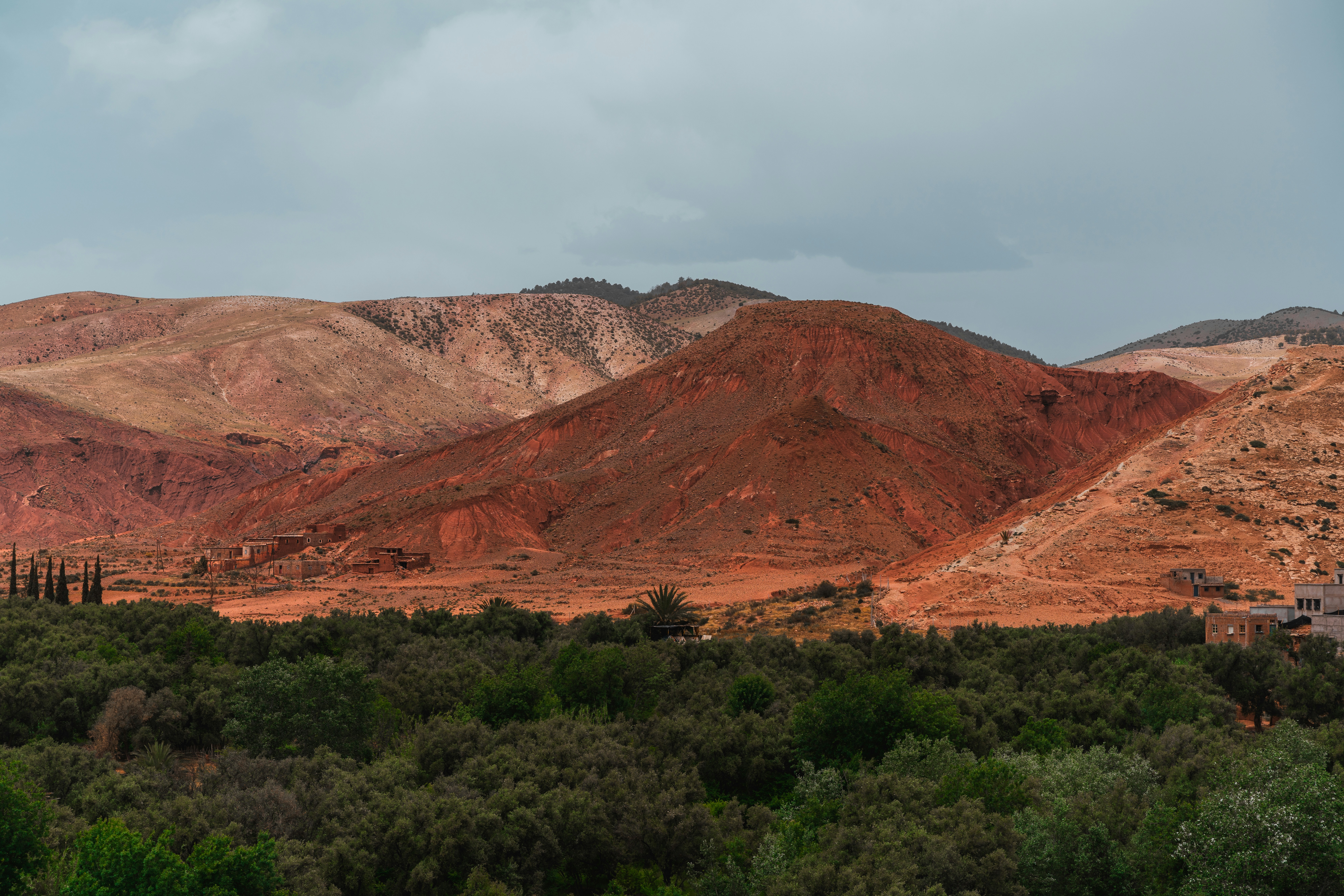
Tafraoute is a small town tucked into the granite hills of the Anti-Atlas mountains in southern Morocco, known for pink-toned rock formations, a fertile valley ringed by traditional villages, and one of the more unusual roadside attractions in the country: a cluster of boulders painted bright colors decades ago. It sits well off the main Marrakech-to-desert tourist route, drawing a smaller, more specific crowd of hikers, climbers, and travelers looking for a quieter corner of the south.
The Ameln Valley
Tafraoute sits at the heart of the Ameln Valley, a wide, fertile basin ringed by the granite peaks of the Anti-Atlas and dotted with dozens of traditional Amazigh villages built directly against the base of the mountains. Almond and argan trees cover much of the valley floor, irrigated by a network of small channels that has supported farming here for generations. The contrast between the pink-grey granite slopes above and the green valley floor below is part of what makes this stretch of the Anti-Atlas visually distinct from the red-earth kasbah country further east.
The Painted Rocks
Just outside the village of Aguerd Oudad, a cluster of large granite boulders was painted blue, purple, and red in the 1980s by a Belgian artist, and the work has been maintained and repainted by locals since. What began as an unusual art project has become one of the most photographed spots in the region, an odd, striking sight against the otherwise natural tones of the surrounding rock. Visitors typically combine a stop here with a walk among the boulders themselves, which are large enough to scramble over and explore.
Granite Boulders and Rock Climbing
Beyond the painted section, the hills around Tafraoute are covered in enormous smooth granite boulders and outcrops, some the size of houses, shaped by centuries of wind and temperature change. This terrain has made the area a recognized destination for rock climbing and bouldering, with routes established across a range of difficulty levels, alongside simpler scrambling and walking for visitors not looking for a technical climb.
The Villages of the Valley
Dozens of small stone and mudbrick villages line the base of the mountains around Tafraoute, many built in tiers up the hillside with flat-roofed houses stacked close together. Some of the oldest villages include fortified granaries, or agadirs, once used to store grain and valuables communally and defend them during periods of conflict. Walking between villages along the valley floor gives a closer look at a way of life still organized around small-scale farming and seasonal almond and argan harvests.
Almond Blossom Season
Tafraoute is known regionally for its almond trees, and when they bloom in late January and into February, the valley floor turns pink and white across a wide stretch of the Ameln Valley. This bloom draws a small seasonal wave of visitors specifically for the flowering trees, a brief window that shifts slightly year to year depending on winter weather. Outside this period, the almond groves still shape much of the valley’s agricultural rhythm, with the harvest itself falling later in the year.
Food in Tafraoute
Meals in Tafraoute lean toward straightforward Moroccan staples, tagine, couscous, and grilled meat, with local specialties built around almonds and argan oil appearing more often here than in most other parts of the country. Amlou, a spread made from roasted almonds, argan oil, and honey, is a regional specialty worth trying, typically served with bread at breakfast or as a snack. Small family-run restaurants around the town center serve the bulk of visitors, alongside a handful of guesthouse kitchens offering home-cooked meals to their own guests.
A Brief History of the Region
The Anti-Atlas has long been home to Amazigh, or Berber, communities who adapted their farming and settlement patterns to the region’s rocky terrain and limited water, building the terraced fields and irrigation channels still visible across the Ameln Valley today. Tafraoute itself grew as a market town serving the surrounding villages, and the region has historically sent many residents to work in trade and commerce in Morocco’s larger cities, with money sent home helping fund some of the more substantial village houses seen today. This connection between the valley and Morocco’s urban trading centers has shaped Tafraoute’s economy for generations, alongside its farming base.
Local Crafts and the Souk
Tafraoute has a modest weekly souk where valley residents come to trade produce, livestock, and household goods, offering a more everyday, working commerce scene than the tourist-oriented souks of Marrakech or Fes. The region is also known for babouche slippers made in distinctive local styles, along with silver jewelry traditionally crafted by Amazigh silversmiths, sold in small shops around the town center.
Day Trips from Tafraoute
Beyond the Ameln Valley itself, the wider region around Tafraoute holds a few worthwhile side trips for travelers spending more than a day or two. The Napoleon’s Hat rock formation, a granite outcrop resembling a bicorne hat, sits a short drive from town and is a common stop alongside the Painted Rocks. Further afield, the road toward Tiznit passes through more of the Anti-Atlas’s rugged scenery, giving a longer scenic loop for travelers with a rental car and extra time.
Where to Stay
Accommodation in Tafraoute ranges from simple guesthouses in town to small kasbah-style riads set within the valley among the almond and argan groves, generally offering a quieter, more scenic base than staying directly in the town center. Because Tafraoute draws a smaller number of visitors than Morocco’s larger tourist destinations, the range of accommodation is more limited, and booking ahead is worthwhile during the almond blossom season or peak hiking months.
Common Misconceptions
A common assumption is that Tafraoute is a major stop on Morocco’s standard tourist circuit. In practice, it sits apart from the usual Marrakech-to-desert route and draws a smaller, more specific crowd, mainly hikers, climbers, and travelers with a particular interest in the Anti-Atlas. Another misconception is that the Painted Rocks are the only reason to visit. The wider granite landscape, the valley villages, and the hiking terrain around Tafraoute offer considerably more than the one well-known photo stop.
Best Time to Visit
Spring, particularly the almond blossom window in late January and February, and autumn bring the most comfortable temperatures for hiking and exploring the valley villages. Summer daytime heat in this part of the Anti-Atlas can be intense, though evenings cool considerably given the elevation. Winter days are generally mild, but nights can turn cold, especially in the higher parts of the surrounding mountains.
Practical Tips for Visiting
Sturdy footwear is worth packing given how much of a Tafraoute visit involves walking over granite boulders and uneven valley paths rather than paved streets. Cash is more reliable than cards outside the town center, particularly at smaller guesthouses and village shops, so it is worth carrying enough for a multi-day stay. Because Tafraoute sees far fewer visitors than Morocco’s major destinations, English is spoken less consistently here than in Marrakech or Fes, and a few words of French or Arabic go a long way with shopkeepers and guesthouse owners.
Getting to Tafraoute
Tafraoute is roughly 150 km from Agadir, approximately 2.5 to 3 hours of driving through the Anti-Atlas mountains on a winding but well-maintained road, and roughly 380 km from Marrakech, approximately 6 to 7 hours, usually routed through Agadir rather than directly over the High Atlas. There is no airport in Tafraoute itself, so most visitors arrive by road, either self-driving or as part of an organized southern Morocco itinerary.
How Tafraoute Fits Into a Wider Morocco Trip
Tafraoute sits apart from the classic Marrakech-to-Merzouga desert route, so it generally works best as a dedicated detour for travelers specifically interested in the Anti-Atlas landscape, hiking, or the almond blossom season, rather than a stop easily folded into a standard multi-day desert tour. Some travelers combine it with time in Agadir, using the coastal city as a base for the drive inland and back.
Frequently Asked Questions
How far is Tafraoute from Agadir?
Tafraoute is roughly 150 km from Agadir, approximately 2.5 to 3 hours of driving through the Anti-Atlas mountains.
What are the Painted Rocks in Tafraoute?
The Painted Rocks are a cluster of granite boulders near the village of Aguerd Oudad that a Belgian artist painted blue, purple, and red in the 1980s, and local upkeep has kept the colors visible since.
What is the Ameln Valley?
The Ameln Valley is the fertile valley surrounding Tafraoute, lined with dozens of traditional Amazigh villages built against the base of the Anti-Atlas mountains.
When is almond blossom season in Tafraoute?
Almond trees around Tafraoute typically bloom in late January to February, drawing visitors for the pink and white blossom display across the valley.
How far is Tafraoute from Marrakech?
Tafraoute is roughly 380 km from Marrakech, approximately 6 to 7 hours of driving, usually routed through Agadir or over mountain roads further south.
Is Tafraoute good for hiking?
Yes, the granite boulder landscape and surrounding Anti-Atlas peaks around Tafraoute offer varied hiking and scrambling terrain that draws climbers and walkers alike.
Browse our Marrakech desert tours for the inland desert route, or see our full range of Marrakech tours if you’re planning a wider Morocco itinerary.