
8 Day Tour from Casablanca to Marrakech
Overview
This 8 day tour from Casablanca to Marrakech is the most complete version of the Casablanca to Marrakech crossing. Eight days means the Sahara gets the two nights it deserves, with the desert camp on Night 5 for the camel trek and a full Day 6 for the 4×4 exploration of the wider Merzouga area: Khamlia Gnawa village, a nomad family visit, the M’ifis salt flats, and the seasonal flamingo lake. Every other stop on the route also has the time it needs.
Day 1 visits Rabat with an afternoon covering the Hassan Tower, the Mausoleum of Mohammed V, and the Kasbah des Oudayas. Day 2 goes north through the Rif Mountains to Chefchaouen. Day 3 stops at Volubilis and arrives in Fes. Day 4 is a full licensed guided day in Fes medina. Day 5 is the long south drive to the Sahara. Day 6 is the Merzouga exploration day. Day 7 moves through Todra Gorge and the Dades Valley. Day 8 completes the crossing via Ait Ben Haddou and the High Atlas into Marrakech.
This 8 day Morocco itinerary Casablanca to Marrakech runs as a private tour for full flexibility and as a shared daily departure at a fixed per-person rate.
Highlights
- Rabat: Hassan Tower, Mausoleum of Mohammed V, and Kasbah des Oudayas
- Blue medina streets of Chefchaouen
- Volubilis Roman ruins and in-situ mosaic floors
- Full day licensed guided tour of Fes medina
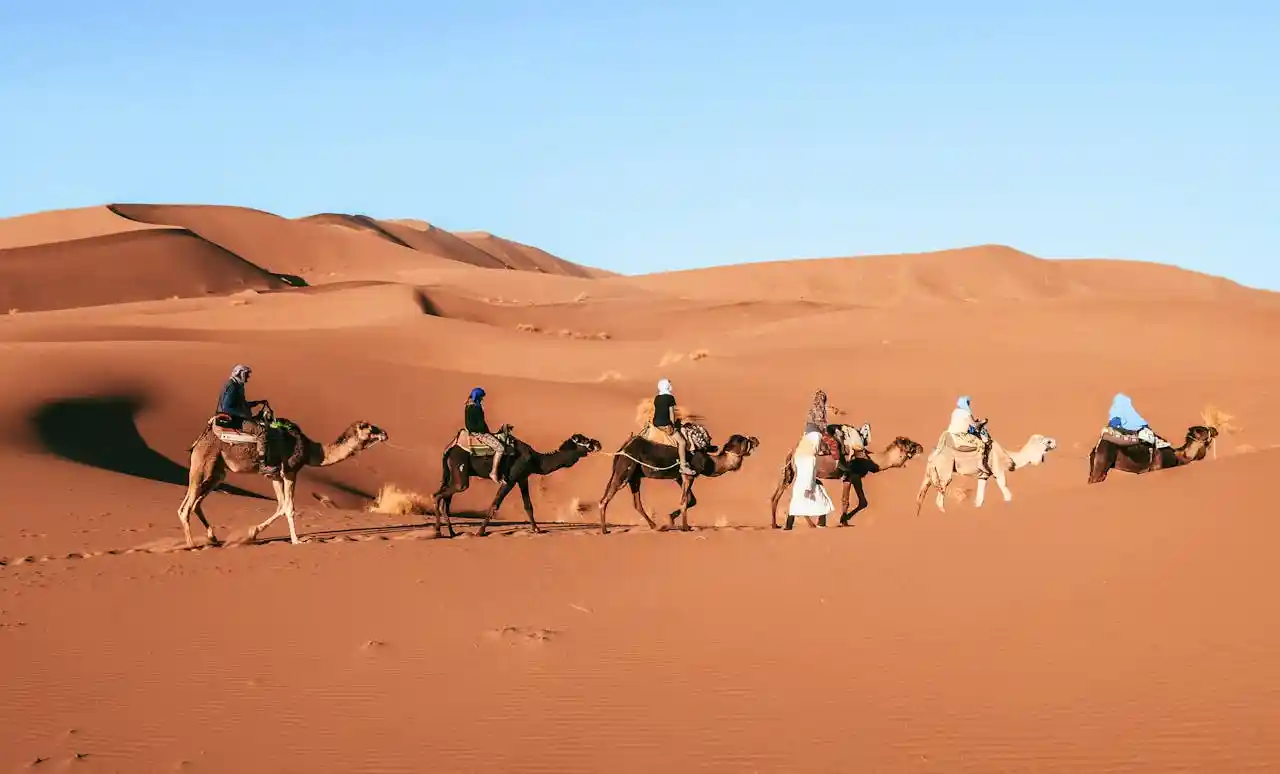
- Sunset camel trek and overnight in the Erg Chebbi desert camp
- Full 4×4 desert exploration: Khamlia Gnawa village, nomad family, M’ifis salt flats
- Todra Gorge canyon walk and Dades Valley monkey finger formations
- Ait Ben Haddou UNESCO ksar and High Atlas Tizi n’Tichka crossing
Itinerary — Day by Day
Day 1 Casablanca → Hassan II Mosque (optional) → Rabat
Your driver picks you up from your Casablanca accommodation or airport at 8:00 AM. If time allows before leaving the city, a stop at the Hassan II Mosque is possible. The mosque sits on a promontory over the Atlantic and the guided interior tour takes about one hour. Whether this stop is included depends on your pick-up time and Day 1 traffic. We confirm this when planning your departure.
We drive north to Rabat, Morocco’s capital and consistently the most underrated city on any Morocco itinerary. The afternoon covers three sites. The Hassan Tower is the unfinished 12th-century minaret that rises from an open plaza beside the columns of what would have been the largest mosque of the medieval world. The project was abandoned when the sultan who commissioned it died and the plaza was left exactly as it was. Directly opposite, the Mausoleum of Mohammed V holds the tombs of Morocco’s late king and his two sons, its interior lined with contemporary Moroccan craftwork in carved plaster, cedarwood, and zellige. The Kasbah des Oudayas sits at the headland where the Bou Regreg river meets the Atlantic. Its whitewashed walls, blue-painted doors, and Andalusian garden inside the ramparts are one of the more quietly impressive combinations in Morocco.
Day 2 Rabat → Rif Mountains → Chefchaouen
After breakfast we leave Rabat and head northeast. The road crosses the Atlantic plain before climbing into the Rif Mountains, where the landscape shifts from open farmland to cedar and pine forest. We arrive in Chefchaouen in the early to mid afternoon.
The blue medina sits in a valley against the mountain face. The colour runs across everything: tiled steps, painted walls, doorways, and the narrow streets running in every direction between them. Most day-trip visitors from Fes leave in the late afternoon. The medina after that hour is quieter, more personal, and more worth walking than the midday version. The main square has a restored kasbah on one side and a row of cafe terraces on the other. The Spanish Mosque hike above the town, 30 to 40 minutes each way on a rocky path, gives the best elevated view of the city against the Rif backdrop. A good use of the late afternoon before dinner.
Day 3 Chefchaouen → Volubilis → Meknes → Fes
After breakfast we descend from Chefchaouen through the Rif Mountains toward the Saiss plateau. The drive southwest takes about two hours before we turn south toward the Zerhoun foothills and Volubilis.
Volubilis is the most significant Roman site in Morocco and one of the best-preserved in all of North Africa. A provincial Roman capital from the 1st century AD, the settlement remained occupied long after Roman withdrawal. The site sits in open farmland with no modern city around it. The Triumphal Arch is the most photographed structure. The in-situ mosaic floors in the residential district are the reason to come. Detailed mythological narrative scenes preserved at ground level in rooms you walk into directly. We allow 90 minutes here. The House of Orpheus and the House of the Acrobat have the most complete floor panels.
We continue to Meknes for a brief stop at Bab Mansour, the ornate 18th-century ceremonial gate built by Sultan Moulay Ismail as the centrepiece of his ambition to build a city to rival Versailles. Then on to Fes, arriving in the afternoon and checking in to your riad. Tomorrow is the full guided day. The evening is yours.
Day 4 Fes Full Day Guided Tour
A full day in Fes el-Bali with a licensed local guide. The medina is a UNESCO World Heritage Site and one of the most intact medieval cities in the world. A licensed guide is not optional here. The streets follow no logical pattern, the tanneries are not visible from street level, and the significant sites are behind doors that look like every other door on the alley. The guide meets you at your riad after breakfast.
The morning covers the Bou Inania Madrasa and its carved cedarwood and zellige tilework, and the Chouara tanneries from the correct viewing terrace, where leather has been processed in the same open stone vats using the same plant-based dyes for over 1,000 years. The afternoon continues through the spice and copper souks, Nejjarine square, and the Andalusian quarter across the river. The guided tour ends around 4:00 PM. Two nights in Fes means the evening after the guide is entirely at your own pace, with no departure pressure overhead.
Day 5 Fes → Ifrane → Cedar Forest → Midelt → Ziz Valley → Merzouga
After breakfast your driver picks you up early. Day 5 is the longest drive of the tour. The road south from Fes crosses the Saiss plateau before climbing into the Middle Atlas. Ifrane is the first stop, the protectorate-era town with tiled-roof chalets and a stone lion at the main square that looks more Swiss than Moroccan. We continue into the cedar forest above Azrou, where Barbary macaques move freely through the trees and around stopped vehicles. Wild, not managed. We allow 20 to 30 minutes before pressing south.
We stop in Midelt for lunch, a market town between the two Atlas ranges with honest food and no tourist pricing. After Midelt the road enters the Ziz Valley, where the road rises above the valley floor and the date palm oasis stretches south as far as the eye can reach, flanked by old ksour and red-clay cliffs. We stop for photographs before the final push through Erfoud and into Merzouga.
We arrive at the camp in the late afternoon in time for the sunset camel trek. The ride into the Erg Chebbi dunes takes about an hour each way at the pace the camels set, the sky turning orange and the sand still warm. Dinner at the camp under open sky, Gnawa music around the fire, overnight in a private tent with en-suite bathroom.
Day 6 Merzouga Full 4×4 Exploration Day
The light outside the tent changes before sunrise. Step outside and find a spot near the camp to watch the sky above the Erg Chebbi dunes turn from dark to gold. The sand is still cold at this hour and the shadows run long and sharp. Breakfast at the camp, then a transfer to the Merzouga hotel to drop bags and collect the 4×4.
The exploration of the wider Merzouga area starts mid-morning. Our first stop is Khamlia, a small village founded by communities who arrived here from West Africa along the pre-colonial trans-Saharan trade routes. The community plays Gnawa music as a living tradition and we arrange a private session in a family compound. The guembri bass and the metallic krakebs are played here as daily practice rather than a visitor performance. It is a completely different register from the campfire music of the night before.
From Khamlia we visit a nomad family encampment beyond the paved roads east of Merzouga. Mint tea, a genuine conversation about the seasonal migration, and the silence that exists in the flat desert beyond the dunes. The M’ifis salt flats are our next stop, crystalline pans that catch the light in unexpected ways. Behind the flats, when the season and rainfall allow, a shallow lake draws flamingos down from the Atlas wetlands. We check conditions before departure and adjust the circuit accordingly. We return to the hotel by mid-afternoon in time for the pool before dinner.
Day 7 Merzouga → Todra Gorge → Dades Valley
After breakfast we leave Merzouga and head west. The desert gives way to open hammada and then the road finds the first green as we approach Tinghir and the Todra Gorge. We arrive before the organised tour groups and walk the tightest section of the canyon, where the walls press to within 10 metres of each other and rise 300 metres above the river running along the floor year-round. After two days in the open desert, the scale of the enclosed gorge takes a moment to absorb.
After Todra we continue west toward the Dades Valley. The road approaching from the east gives the best first view of the monkey finger formations, the columns of folded limestone that jut from the canyon walls above the hotel cluster. These geological formations are specific to this section of the upper gorge and look more deliberate than natural from the road below. We stop at the zigzag road viewpoint above the gorge, where a series of hairpin bends cut into the canyon wall give a view back down the valley and toward the Atlas rising behind it. One of the better photographs of the tour. We descend to the valley floor and check in to the hotel. Dinner and overnight.
Day 8 Dades Valley → Rose Valley → Ouarzazate → Ait Ben Haddou → High Atlas → Marrakech
After breakfast we head west along the pre-Saharan corridor. The road passes through the Rose Valley between Kelaat M’gouna and Boumaln Dades, where Damascus roses are grown for cosmetics and rose water. In April and May the roadside is planted in pink and the distilleries are running. The valley is worth the drive in any season for its terraced gardens and the kasbah walls above the river.
We arrive in Ouarzazate around midday and stop at Kasbah Taourirt, the former administrative centre of the Glaoui clan. We then continue west to Ait Ben Haddou, the UNESCO-listed ksar whose earthen towers rise above the Ounila River. Recognised as a World Heritage Site in 1987, the fortified village has appeared in Gladiator, Game of Thrones, and Babel. We allow a full 90 minutes to walk from the river crossing at the base to the granary at the summit and to understand the scale of the settlement from above.
After the ksar we begin the climb into the High Atlas. The Tizi n’Tichka Pass at 2,260 metres is the highest paved road in Morocco. The road switchbacks up through the southern mountain face before the long descent into the Marrakech plain. We arrive in the late afternoon and drop you at your riad or the nearest accessible point. Eight days, the Atlantic capital, the Blue City, the Roman ruins, Fes, the Sahara, the gorges, and the High Atlas.
What Is Included
Included
- ✔Pick-up from your Casablanca accommodation or airport at 8:00 AM
- ✔Private air-conditioned vehicle and English-speaking driver-guide throughout
- ✔7 nights: Rabat (Night 1), Chefchaouen (Night 2), Fes (Nights 3 and 4), Erg Chebbi desert camp (Night 5), Merzouga hotel (Night 6), Dades Valley hotel (Night 7)
- ✔Breakfast at Rabat, Chefchaouen, and both Fes mornings
- ✔Dinner and breakfast at the desert camp and Merzouga hotel
- ✔Dinner and breakfast at the Dades Valley hotel
- ✔Rabat sightseeing: Hassan Tower, Mausoleum of Mohammed V, Kasbah des Oudayas
- ✔Volubilis visit and Meknes Bab Mansour stop on Day 3
- ✔Full day licensed local guide in Fes medina on Day 4
- ✔Sunset camel trek into the Erg Chebbi dunes
- ✔Sandboarding at the desert camp
- ✔Full Day 6 4×4 exploration: Khamlia, nomad family, M’ifis salt flats, seasonal lake
- ✔Drop-off at your Marrakech riad or nearest accessible point
- ✔All fuel and road tolls
Not Included
- ✘Flights to Casablanca or from Marrakech
- ✘Lunches and drinks
- ✘Dinners in Rabat, Chefchaouen, and Fes (own account)
- ✘Entry fees (Hassan II Mosque, Volubilis, Fes medina sites, Ait Ben Haddou)
- ✘Accommodation in Marrakech
- ✘Tips (optional)
- ✘Optional: ATV, quad bike at Merzouga
Accommodation
Three tiers, same route and experiences across all. WhatsApp us for a full price breakdown by group size and dates.
Desert camp tents include private en-suite bathrooms and hot water, climate-controlled in summer and winter. Message us for pricing by group size.
Price
This 8 day Morocco itinerary Casablanca to Marrakech starts from €1,369 per person. The final price depends on your group size, travel dates, and accommodation tier. Larger private groups pay less per person. Shared departures are available at a fixed per-person rate.
Group size
Private tours: the vehicle cost is fixed and divides across the group. Shared tours: fixed price per person regardless of group size.
Season
Spring and autumn are the busiest and most expensive periods. Better availability and lower rates in January, February, and June. Summer at Erg Chebbi can exceed 42 degrees, making the Day 6 outdoor exploration more demanding.
Tier
Standard, mid-range, and premium across seven overnight stops. Same route and experiences throughout.
Book Your Tour
Request a Free Quote
Tell us your travel dates, group size, and preferred tier. We reply within one hour, seven days a week. No deposit needed to enquire.
Why Choose This Tour
The full Day 6 at Merzouga is what separates this tour from the 7-day version. On a 7-day tour the desert gets one night and the camel trek. On this tour it gets two nights and an entire day of 4×4 exploration that covers the parts of the Merzouga area the camel trek never reaches. Khamlia village, the nomad encampments, the M’ifis salt flats, and the seasonal flamingo lake are all beyond the dunes themselves. The Gnawa session in Khamlia is played by people for whom this is a daily practice, not an evening performance. That context is what makes the visit different from anything that happens at the camp.
The structural logic of eight days is also simply better. The north section has Rabat, Chefchaouen, Volubilis, and two nights in Fes. The south section has the Sahara properly, the gorges, and the High Atlas. Nothing is abbreviated and nothing is rushed. The transitions between landscapes happen at the pace the landscapes deserve.
Arriving in Marrakech at the end of Day 8, having started in Casablanca and covered the country in between, is a different experience from arriving at the start of the trip. The city at the end of eight days makes sense in a way it cannot at the beginning.
Who This Tour Suits
Casablanca in on a Saturday, Marrakech out the following Sunday. Eight days, seven completely different overnight stops, not a single road used twice.
Day 6 is the day that goes past the dunes. Khamlia, the nomad family, the salt flats. The version of Merzouga most visitors never reach.
Volubilis, Fes el-Bali, and Ait Ben Haddou in six of the eight days. Three different civilisations at their most intact, with the Sahara and the gorges between them.
Every stop is private and every day’s pace is yours. The Khamlia session and the nomad family visit are arranged exclusively for your group.
Know Before You Go
The interior is accessible by guided tour only, taking about one hour. Dress modestly. Whether we include this depends on your pick-up time and traffic. Confirm with us when planning your Day 1 departure. If you are flying in on the morning of Day 1, let us know your arrival time and we plan accordingly.
The medina streets are too narrow for vehicles. Your driver parks outside and you walk to the riad with a porter often meeting you at the gate. Wheeled luggage is easier than hard cases for this section. The walk from the main gate to most riads is five to ten minutes.
Fes to Merzouga is around 430 km and takes seven hours with stops. We leave early from the riad. Having slept two nights in Fes means Day 5 begins from rest. The cedar forest, Midelt, and the Ziz Valley all break the drive naturally.
Your main luggage stays in the vehicle at Merzouga. Take a small bag to the camp for one night: a change of clothes, a warm layer for the desert evening, and basic toiletries. The camel carries your bag to the tent. Everything else transfers to the Merzouga hotel on Day 6 morning.
We schedule Khamlia for mid-morning before the heat builds. The Gnawa session is in a family compound and takes around 45 minutes. No photography during the performance without asking first. The visit works best when it is unhurried and approached as what it is: a visit to someone’s home.
October through April for the most comfortable conditions across all eight days. Spring adds the Rose Valley in bloom on Day 8. The Rif Mountains in December and January can be cold and wet. Summer at Erg Chebbi regularly exceeds 40 degrees, making the Day 6 outdoor exploration harder.
Reviews
“Day 6 was the best day of the whole trip. The Khamlia session in the morning was unlike anything I had heard before. The nomad family visit after that was genuine and unhurried. The flamingo lake in the afternoon still does not make sense to me geographically. Eight days was exactly the right amount of time for this crossing.”
“Rabat on Night 1 set the tone for the whole tour. The Kasbah des Oudayas at the end of the afternoon, the Bou Regreg river below and the Atlantic ahead of it. The Volubilis mosaics two days later. The Fes guided day. The Sahara sunrise near the camp. Eight distinct things from eight days.”
“The zigzag road viewpoint above the Dades Valley on Day 7 was a surprise. Our driver stopped without being asked. The valley below and the Atlas behind it in one frame. That was the photograph of the eight days. The Ait Ben Haddou ksar on Day 8 in the late afternoon light was the right ending.”
Frequently Asked Questions
Only have 7 days?
The 7-Day Tour from Casablanca to Marrakech covers the same full route but with a single desert camp night rather than two nights near Erg Chebbi, and without the Day 6 Merzouga exploration. Same Fes guided day, same gorges, one fewer day in the south.
Looking for a shorter crossing?
The 6-Day Tour from Casablanca to Marrakech starts from Chefchaouen on Day 1 rather than Rabat, and covers Volubilis, a full Fes day, and the desert in six days without the Merzouga exploration.
Book Your 8 Day Tour from Casablanca to Marrakech
Private and shared departures run daily year-round. We pick you up from your Casablanca accommodation or airport at 8:00 AM on Day 1 and drop you at your Marrakech riad eight days later. No commitment needed to get a quote.
Request a Free Quote WhatsApp Us